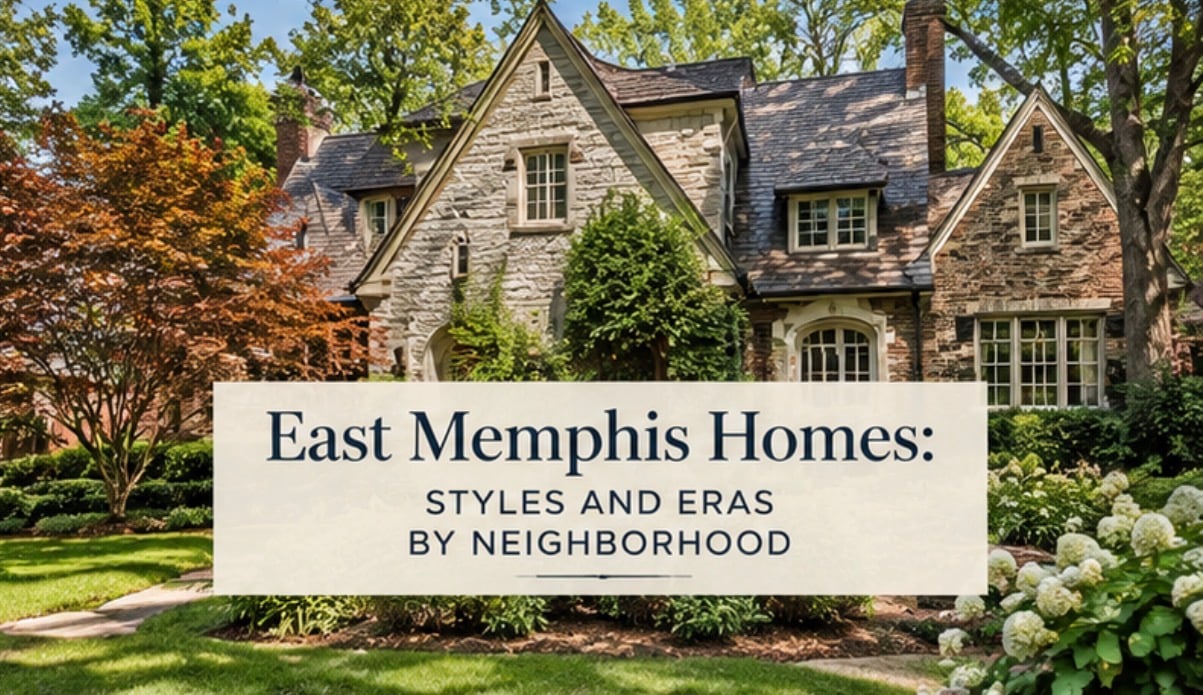
East Memphis Homes: Styles and Eras by Neighborhood
East Memphis Kelly Day October 5, 2026
East Memphis Kelly Day October 5, 2026
East Memphis is not one kind of house. Within a few miles you can go from a 1920s Tudor on an acre lot to a tidy 1950s brick ranch to a glass-walled mid-century modern tucked behind tall trees. That range is part of the appeal, and it is also why two homes with an East Memphis address can feel like they belong to different cities. Here is a neighborhood-by-neighborhood look at what was built where, and when.
Some of the oldest planned neighborhoods in East Memphis sit close to the University of Memphis side of the area.
Red Acres was laid out in 1923 on 136 acres bounded by Walnut Grove Road, Poplar Avenue, Highland Street and Goodlett Street. Memphis Heritage describes the homes as a mix of Tudor Revival, Classical Revival and Mediterranean styles, with Minimal Traditional and ranch houses added after World War II. Lots are generous, averaging about half an acre, and many are larger than an acre.
The Village came a little later. Its plat was approved in 1938, and both the street layout and many of the houses were designed by Memphis architect J. Frazer Smith. It runs from Poplar Avenue south to the railroad, between Williamsburg Lane and Greenfield Road. The houses are mostly Colonial Revival and Minimal Traditional, on a smaller and more uniform scale than Red Acres.
The largest share of East Memphis housing went up after the war, and most of the area had been annexed into Memphis by the mid-1960s.
Colonial Acres began in 1953 as a planned development of more than 1,300 homes. It stretches from Park Avenue south to I-240 and from Cherry Road east to Mt. Moriah Road. The houses are mostly brick, traditional in form with some modern touches, and the original developers required two oak trees on every lot, which explains the canopy you see today. Homes.com puts the median year built at 1954, with ranch plans being the most common.
Sea Isle Park sits in the curve of I-240, south of the railroad and east of Mt. Moriah. The neighborhood association counts about 3,000 homes, mostly detached brick houses built in the 1950s and 1960s. The park at its center has an 18-hole disc golf course, a dog park and an arboretum.
Normandy Meadows, between Quince and Ridgeway roads, was built in the late 1950s and early 1960s. Single-story brick ranches on broad lots are the signature here.
East Memphis also has a quiet collection of architect-designed modern houses from the 1960s and 1970s. The Memphis chapter of the American Institute of Architects featured several on a 2024 tour, including a 1961 house on Waring Road by A.L. Aydelott and a 1961 house on Shady Glen by Lawrence T. Hord. These homes come up for sale rarely and tend to have features such as terrazzo floors and clerestory windows that are costly to reproduce and worth protecting.
Farther east, in the 38120 zip code, River Oaks is newer. Most of its homes were built between 1970 and 1999, in traditional, contemporary and Colonial Revival styles, generally with more square footage than the postwar ranch neighborhoods.
A few facts apply across the area:
Poplar Avenue, Walnut Grove Road and Park Avenue are the main east-west routes, with Perkins, Mendenhall and White Station running north-south. The Dixon Gallery and Gardens on Park Avenue and the Memphis Botanic Garden on Cherry Road sit across from each other near Audubon Park. Laurelwood Shopping Center is on Poplar at Grove Park Road. Nearby, the interior of Oak Court Mall closed in April 2026 and the site is slated for redevelopment with apartments and retail, though no completion date has been announced. On the north side, the Shelby Farms Greenline has access points at Highland Street, Graham Street, Waring Road and Podesta Street.
If you are trying to figure out which part of East Memphis fits the kind of house you have in mind, I am glad to help you compare neighborhoods or look closely at a particular home. There is never any pressure. Reach out whenever it would be useful.
Kelly Day, SRES, SRS, AHWD, PSA, RENE
Multi Million Dollar Club
Broker Lic # 365811
simpliHOM
901-289-9227
855-856-9466
[email protected]
https://memphishouselistings.com
Downtown Memphis
Bartlett
East Memphis
Collierville
Germantown
Downtown Memphis
Midtown Memphis

Rossville
Collierville
We'd love to hear from you! Whether you're buying, selling, or just exploring your options, we're here to provide answers, insights, and the support you need. Contact us and start planning your next move.