
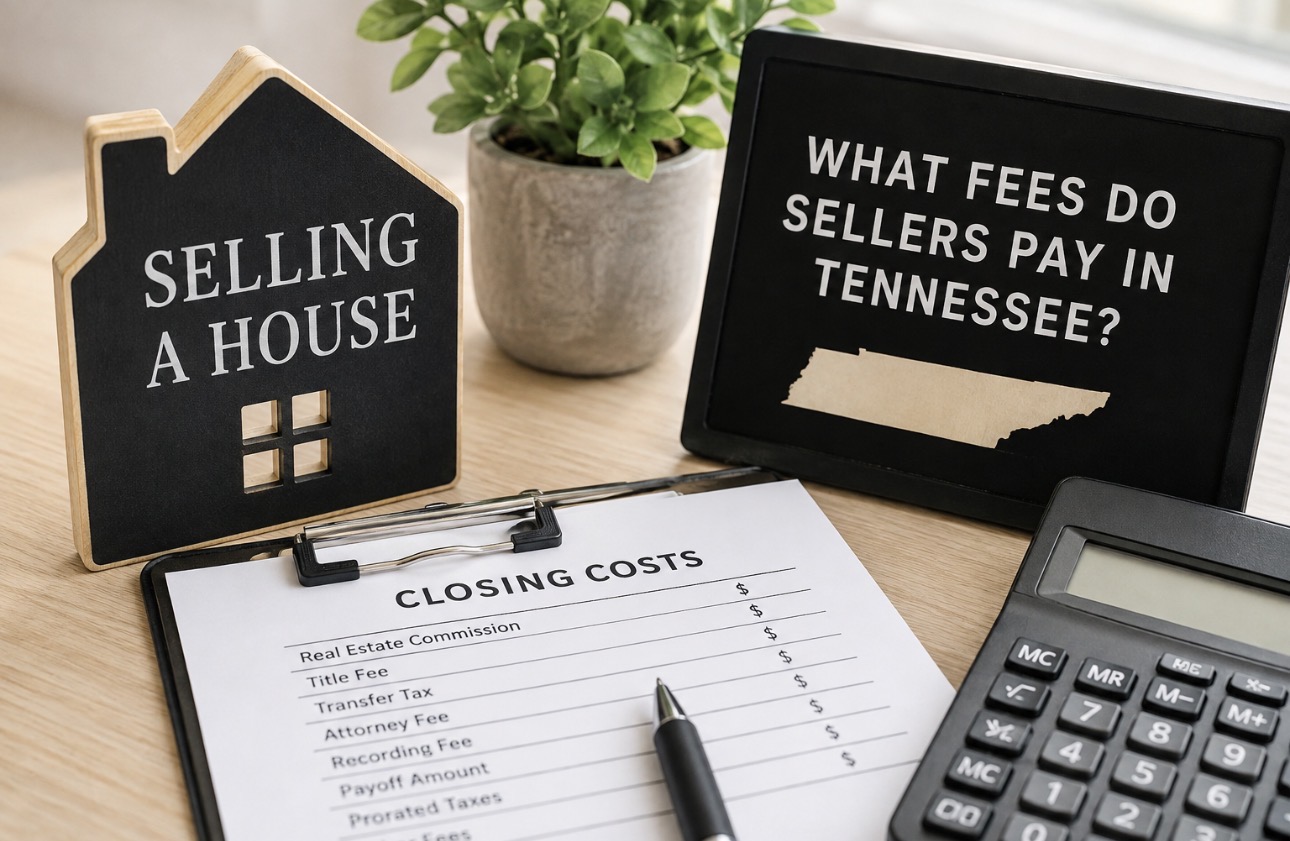
What Fees Do Sellers Pay When Selling a House in Memphis, TN?
What Fees Do Sellers Pay When Selling a House in Memphis, TN?
If you're thinking about selling your Memphis home, one of the first questions you’re probably asking is:
“How much money am I actually going to walk away with?”
That's a really good question—and it's one that doesn't have a simple answer.
The price your house sells for isn't necessarily the amount that ends up in your bank account. There are several costs that can come out of your proceeds along the way.
The good news is that most of these expenses aren't a surprise. If you work with your agent and closing professionals ahead of time, you can get a pretty good idea of what yournet proceedscould look like before you ever put the house on the market.
Here's a look at some of the costs Memphis sellers should know about.
1. Real Estate Agent Compensation
If you work with a real estate agent, there may be compensation owed to your listing agent and potentially to a buyer's agent.
This is an important area to understand becausereal estate compensation is negotiable and isn't a fixed government-mandated percentage.
Your listing agreement should clearly explain what you're agreeing to pay.
It's also worth knowing that sellers may choose to offer compensation toward a buyer's agent as part of the overall strategy for marketing and selling the home. That amount, if any, is negotiable and should be discussed with your agent.
The important thing is to understand the numbers before you sign the listing agreement—not after you accept an offer.
2. Tennessee Realty Transfer Tax
Here's one that's specific to Tennessee.
Tennessee charges a realty transfer tax when real property is transferred. The current rate is$0.37 for every $100 of the property's value or consideration, whichever is greater.
So, as a simple example, if your home sells for $400,000:
$400,000 ÷ $100 × $0.37 = $1,480
That's a cost worth accounting for when you're estimating your proceeds.
3. Title and Closing Expenses
There are also expenses associated with getting the transaction closed.
Depending on the transaction and how the contract is written, these can include things like title-related services, document preparation, recording-related charges, and other closing expenses.
Who pays which costs can vary based on the contract, the type of transaction, and local practices.
That's why you shouldn't rely on a generic “seller closing costs are always X%” rule.
Your closing professional can provide an estimate based on your specific transaction.
4. Paying Off Your Mortgage
This one isn't technically a “selling fee,” but it's obviously a huge factor in determining how much money you take home.
If you still owe money on your mortgage, your loan payoff will generally come out of your proceeds at closing.
For example:
Sale price:$400,000
Mortgage payoff:-$220,000
That leaves $180,000 before accounting for the other costs of selling.
If you've owned your home for several years and built up equity, this is where you may see a significant portion of that equity come back to you.
And if you have a second mortgage, home equity loan, or other lien on the property, those may need to be paid off as well.
5. Property Taxes and Other Prorated Expenses
Property taxes and certain other expenses may be prorated between the buyer and seller at closing.
In other words, you may not necessarily be responsible for the entire year's property taxes if you sell partway through the year.
Instead, the closing statement will generally account for the portion attributable to each party based on the terms of the transaction and applicable local requirements.
This is one of those things that can look confusing on a settlement statement, but your closing professional can walk you through it.
6. HOA or Neighborhood Fees
If your home is part of an HOA or homeowners association, there may be fees involved with selling.
Depending on the association, you could run into things such as:
Transfer fees
Document or resale package fees
Outstanding dues
Prorated assessments
Other association charges
These vary from one neighborhood to another, so it's worth finding out what your HOA requires before you list.
7. Repairs and Getting the House Ready to Sell
This isn't technically a closing cost, but it's one of the biggest expenses sellers sometimes forget about.
Before listing, you may decide to spend money on things like:
Touch-up painting
Landscaping
Deep cleaning
Carpet cleaning
Minor repairs
Pressure washing
Decluttering
Professional photography
Staging
Here's the thing, though:
You don't necessarily need to do everything.
One of the benefits of having a realtor walk through your home before you list is figuring out which projects are actually worth doing.
Spending $15,000 getting a house “perfect” doesn't make sense if the improvements aren't likely to help you sell for enough more to justify the expense.
Sometimes a $500 repair is worthwhile.
Sometimes spending $10,000 on a kitchen remodel right before selling isn't.
It depends on the house, the neighborhood, the competition, and what buyers are looking for.
8. Seller Concessions
Sometimes a buyer will ask the seller to contribute toward certain costs.
For example, a buyer might request a credit toward closing costs or ask for a credit related to an inspection issue.
Whether you agree is completely part of the negotiation.
A seller concession isn't necessarily a bad thing. Sometimes giving a reasonable credit can help keep a transaction together or make your home more attractive to buyers.
But it's important to look at thewhole offer, not just the price.
An offer of $410,000 with $10,000 in seller concessions isn't the same as an offer of $410,000 with no concessions.
That's why looking at the estimated net proceeds is so important.
9. Moving Expenses
Let's not forget about the expense that comes after the closing statement:
Actually moving.
Depending on your situation, you could have costs for:
Movers
Packing materials
Storage
Temporary housing
Cleaning
Utility transfers
Transportation
If you're selling your current home and buying another one, these costs can add up quickly.
They're not part of your real estate closing costs, but they're still part of the overall financial picture of your move.
So How Much Does It Cost to Sell a House in Memphis?
This is where I wish there were a simple answer.
You may see articles online saying that sellers should expect to pay a certain percentage of the sale price.
The problem is thatthere isn't one universal percentage that applies to every Memphis home sale.
Your actual costs depend on things like:
Your sale price
Your mortgage balance
Your agent compensation agreement
Buyer-agent compensation, if offered
The terms of your contract
Repairs and preparation
HOA fees
Property taxes
Seller concessions
Title and closing expenses
Other liens or obligations
That's why I prefer to look at a seller'sestimated net proceedsrather than throwing around one percentage.
Here's a Simple Example
Let's say you sell your Memphis home for$400,000.
You might start with:
Sale price:$400,000
Then subtract things like:
Mortgage payoff:-$220,000
Tennessee transfer tax:-$1,480
Agent compensation:varies
Other closing expenses:varies
Repairs/concessions:varies
What's left is your estimated net proceeds.
And that's the number you really care about.
Not the $400,000 sale price.
Before You List, Get Your Numbers
If you're considering selling, don't wait until you've accepted an offer to figure out what you'll walk away with.
A good first step is to have your agent prepare aseller net sheetbased on a realistic potential sale price.
It's not going to predict the final closing statement down to the penny, but it can give you a much clearer picture of what you're working with.
That can help you answer some really important questions:
How much money will I have for my next house?
Can I afford to move?
Should I make repairs before listing?
Do I have enough equity to accomplish what I want to do next?
What price do I actually need to sell for?
Those answers can make a huge difference in your selling strategy.
The Bottom Line
Selling a house isn't as simple as putting a sign in the yard, accepting an offer, and depositing a check.
There are expenses along the way, and they can vary quite a bit from one seller to another.
But that doesn't mean the process needs to be confusing.
Before you list your Memphis home, know your numbers.
Understand what you owe, what your likely selling costs will be, what improvements are actually worth making, and—most importantly—what you can realistically expect to take home after the sale.
If you're thinking about selling a home in Memphis, Bartlett, Germantown, Collierville, Arlington, or the surrounding area, I'd be happy to help you work through the numbers before you make any decisions.
Because knowing what you'llactually walk away withis a whole lot more useful than simply knowing what your house might sell for.
Kelly Day, SRES, SRS, AHWD, PSA, RENE
Multi Million Dollar Club
Broker Lic # 365811
simpliHŌM
901-289-9227
855-856-9466
[email protected]
https://memphishouselistings.com