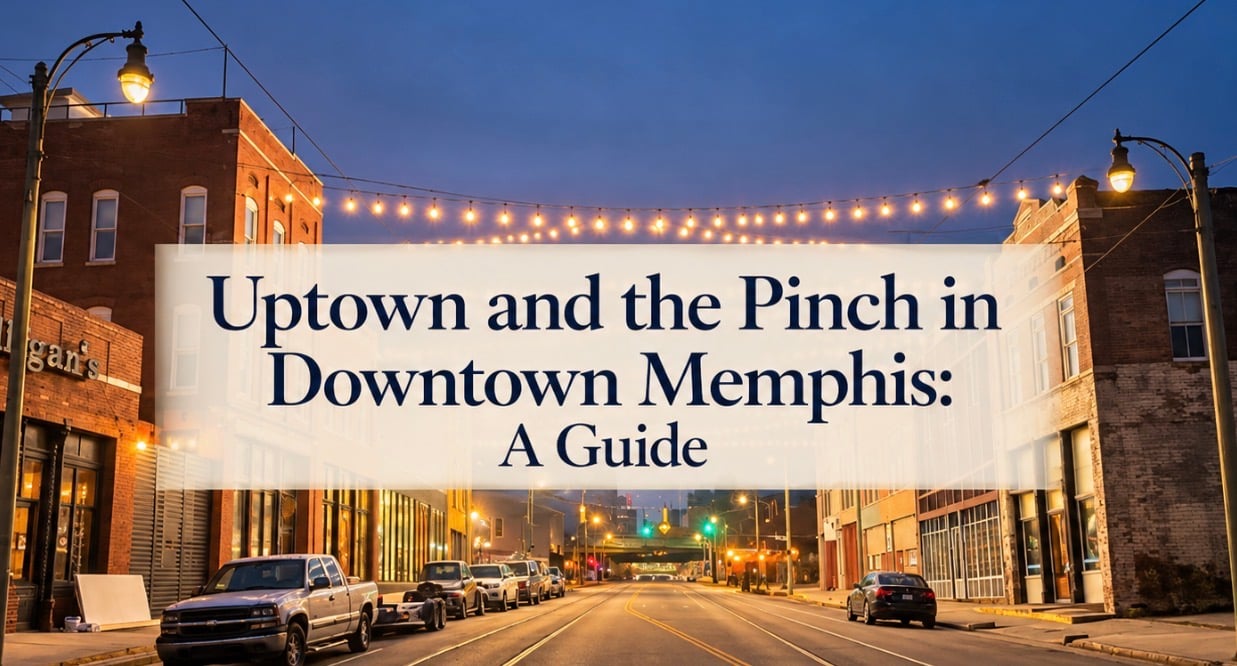
Uptown and the Pinch in Downtown Memphis: A Guide
Downtown Memphis Kelly Day October 11, 2026
Downtown Memphis Kelly Day October 11, 2026
The north end of Downtown Memphis does not get as much attention as South Main or the riverfront, but it has one of the longest histories in the city and some of the most varied housing. Two connected areas make up most of it: the Pinch District, just north of the convention center, and Uptown, which stretches north from there along the Wolf River Harbor. If you are getting to know Downtown Memphis, this corner is worth understanding.
The Pinch District is generally described as the area between the Wolf River lagoon on the west and Danny Thomas Boulevard on the east, from Market Street north to A.W. Willis Avenue. North Main Street runs through the middle of it, and Interstate 40 crosses the neighborhood on its way to the Hernando de Soto Bridge.
Uptown begins on the other side of A.W. Willis Avenue. The name dates to 1999, when a public-private partnership began a revitalization effort in what had long been called Greenlaw. Today Uptown covers roughly 100 city blocks east of the harbor. The historic Greenlaw core is the 30 or so blocks closest to the water, bounded by A.W. Willis Avenue, North Seventh Street, Keel and Chelsea Avenues, and the Wolf River. St. Jude Children's Research Hospital sits just to the east, and Harbor Town and Mud Island are across the harbor. Zip codes in this part of town include 38103, 38105 and 38107.
The Pinch was part of the original plan of Memphis and served as the city's first commercial district. The Greenlaw Addition came a little later. It was laid out in 1856 as an extension of the downtown street grid, with cobbled streets, granite curbs and tree-lined boulevards. Several east-west streets still carry the names of the people who platted it: Greenlaw, Saffarans, Looney and Keel. Mill Street takes its name from the mills that once lined the riverfront, and North Seventh Street was originally called High Street.
Both the Pinch-North Main area and the Greenlaw Addition are listed on the National Register of Historic Places. A few buildings hint at the area's earlier chapters, including the four Love cottages on North Sixth Street, built in 1890 and later restored by the preservation group Memphis Heritage.
The twentieth century brought large changes. Interstate 40 was built through the Pinch in 1973, and the Pyramid opened on the lagoon in 1991. In 2000 the city received a federal HOPE VI grant tied to the redevelopment of the former Hurt Village site, which opened the way for much of the newer housing in Uptown.
Uptown is a place where a house from the late 1800s can sit a few doors from one built in the 2000s. St. Jude's neighborhood guide describes late nineteenth and early twentieth century homes with covered porches alongside newer single-family homes and apartments. Other descriptions of the area mention bungalows, shotgun houses and two-story traditional homes, many on compact lots with small front yards and sidewalks.
Much of the newer construction was designed to echo the older houses, with front porches, narrow lots and rear or alley parking. The result is a walkable street pattern that feels different from the high-rise and loft buildings in the downtown core. The Pinch itself is more commercial, with storefront buildings along North Main Street.
If you are considering a home here, it helps to look closely at the age of the specific house. An 1890s cottage and a 2005 build call for very different inspections, and both can be found on the same block.
The most visible landmark is the Pyramid, which reopened in May 2015 as Bass Pro Shops at the Pyramid, with a hotel and an observation deck. The Cannon Center for the Performing Arts, which opened in 2003 and seats 2,072, sits at the south edge of the Pinch next to the convention center. Alcenia's, a long-running soul food restaurant on North Main Street, is a familiar stop in the district.
In Uptown, Greenlaw Park and its community center offer a playground, basketball court and picnic space. Mud Island's walking and biking paths are close by, and Harbor Town's grocery store and restaurants are a short drive across the A.W. Willis bridge. To the north, the Snuff District is a redevelopment of a former tobacco warehouse area of about 60 acres, planned as a mix of apartments, offices and restaurants.
The Main Street Trolley line runs north through the Pinch, and MATA's North End Terminal on North Main is the city's main bus hub. Interstate 40 is right at hand for trips east toward Midtown and East Memphis or west into Arkansas, and North Parkway is a direct surface route to Midtown.
Large redevelopment plans for the Pinch have been announced more than once over the past decade, including a mixed-use district tied to St. Jude's expansion and a pedestrian bridge to the Pyramid. Timelines for projects like these tend to shift, so it is wise to check the current status of anything that would influence your decision instead of relying on an older announcement.
If you are curious about Uptown, the Pinch or anywhere else in Downtown Memphis, I would be glad to share what I know and help you look at specific streets. Reach out whenever it is useful to you.
Kelly Day, SRES, SRS, AHWD, PSA, RENE
Multi Million Dollar Club
Broker Lic # 365811
simpliHOM
901-289-9227
855-856-9466
[email protected]
https://memphishouselistings.com
Lakeland
East Memphis
Downtown Memphis

Collierville
Germantown
East Memphis
Midtown Memphis

Collierville
Germantown
We'd love to hear from you! Whether you're buying, selling, or just exploring your options, we're here to provide answers, insights, and the support you need. Contact us and start planning your next move.