Homes in Germantown, TN: Eras, Styles and Lot Sizes
Germantown Kelly Day October 11, 2026
Germantown Kelly Day October 11, 2026
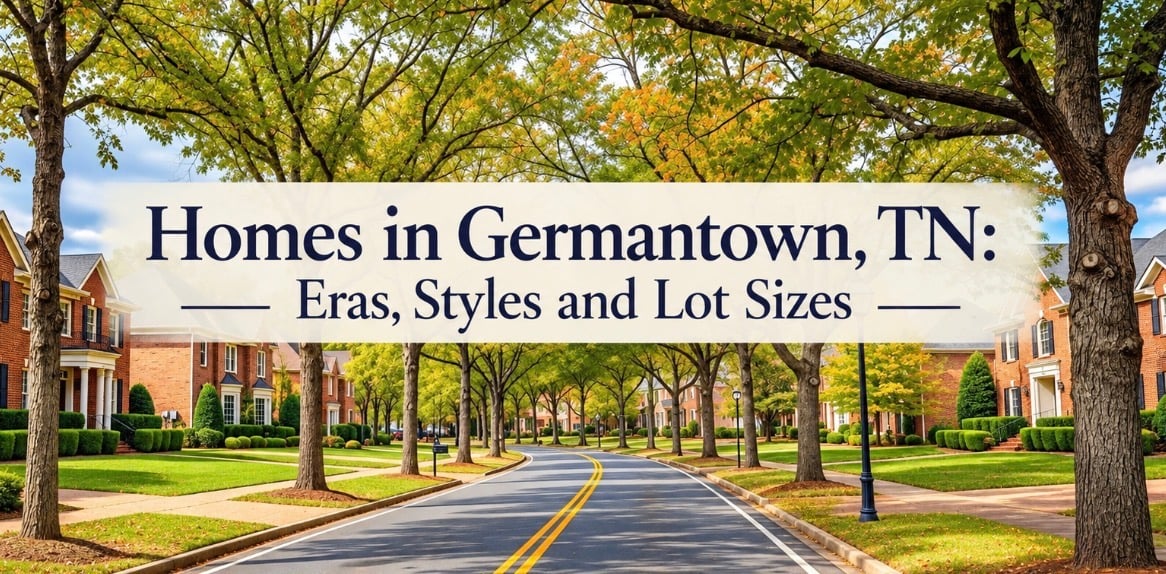
If you spend an afternoon driving through Germantown, TN, you start to notice that the houses tell you roughly when each part of the city was built. Low brick ranches give way to two-story traditionals, and farther east the rooflines get taller and the garages get wider. Knowing a little about those eras makes it much easier to read a listing in 38138 or 38139 and to understand what you are looking at before you ever walk through the door.
Germantown was incorporated in 1841, but for more than a century it stayed very small. Census counts show 1,104 residents in 1960 and 3,474 in 1970. Then the city changed quickly: 21,467 in 1980, 32,893 in 1990 and 41,333 in 2020. Most of the housing you see today traces back to that stretch of growth.
The Germantown history archive keeps a list of subdivision plats by year, and it lines up with those numbers. A handful of early names appear first: Germantown Heights in 1957, Kirby Hills in 1960, English Meadows in 1963 and Riverdale Park in 1965. Additions to Poplar Estates, Apple Valley and Germantown Gardens followed in the late 1960s. The 1970s were the busiest years on the list, with Miller Farms, Dogwood Trails, Kimbrough Woods, Farmington, Oaks of Germantown, Fox Creek, Duntreath and Germantown Station all platted during that decade. In that archive, 1976 through 1978 alone account for dozens of entries.
Because so much of the city was laid out in the 1970s and 1980s, the most common Germantown house is a brick traditional from those years. Homes.com's neighborhood guide for Poplar Estates, for example, describes brick ranch and split-level homes with Colonial details such as columns and pitched roofs, and lists a median year built of 1973 for that neighborhood.
Across the city as a whole, the same site describes a mix of classic ranch, Colonial Revival and Tudor-inspired designs, along with homes that have full-height columns across the front. It lists a citywide median year built of 1981. Newer custom construction shows up too, and Chapel Cove is one example the guide names. There are also condominium and townhome communities, some with shared amenities such as a pool or clubhouse.
One thing that ties the eras together is the city's long-standing attention to how things look. Germantown has a Design Review Commission among its advisory boards, and planning and appearance standards have shaped development here for decades. That is a large part of why commercial corridors along Poplar Avenue and Germantown Road look the way they do.
Germantown covers about 20 square miles, and most of it is single-family neighborhoods on curving streets and coves. Homes.com shows a median lot size of roughly 15,245 square feet for the city, which is a little over a third of an acre. That figure was on the site when checked in October 2026, and individual lots vary quite a bit. Some properties in older sections sit on close to half an acre, while townhome and zero-lot-line communities are much smaller.
Mature trees are a big part of the picture in the sections built forty and fifty years ago. So is the park system. The city reports 27 parks and more than 11 miles of greenway, and many subdivisions were planned around a neighborhood park. Farmington Park, Poplar Estates Park, Riverdale Park and Germantown Station Park all share a name with the streets around them.
A house from the 1970s or 1980s can be a wonderful place to live, and it also has a history. A few things are worth asking about, whether you are buying one or getting ready to sell one:
None of these are reasons to worry. They are simply the questions a good home inspector will raise, and it helps to have answers ready. Sellers who gather service records and receipts ahead of time usually have a smoother experience once a contract is in place.
Floor plans changed along with the exteriors. Earlier homes often have a formal living room and dining room at the front with a den at the back. Later plans tend to open the kitchen to the main living area and add a primary bedroom on the ground floor. If single-level living matters to you, the ranch homes in earlier sections such as Poplar Estates are worth a look. If you want a newer layout, subdivisions built in later decades may fit better.
If you would like help sorting through Germantown neighborhoods by age, layout or lot size, I am always glad to talk it through. There is no pressure and no timeline. Sometimes a short conversation is all it takes to narrow things down.
Kelly Day, SRES, SRS, AHWD, PSA, RENE
Multi Million Dollar Club
Broker Lic # 365811
simpliHOM
901-289-9227
855-856-9466
[email protected]
https://memphishouselistings.com
Lakeland
East Memphis
Downtown Memphis

Collierville
Germantown
East Memphis

Midtown Memphis
Collierville
Germantown
We'd love to hear from you! Whether you're buying, selling, or just exploring your options, we're here to provide answers, insights, and the support you need. Contact us and start planning your next move.